
Northern lights in Greenland: when, where and how to see them
Greenland lies under the band of sky where the aurora is most frequent. Here is when to come, where to stand in Nuuk, Kangerlussuaq and Ilulissat, how to read the forecasts, and how to photograph the lights with a phone.
You can see the northern lights in Greenland on clear, dark nights from about September to early April. Kangerlussuaq has the most clear nights; in Nuuk you only need to walk to the edge of town. Look in every direction, including straight up, and give it time.
- Season 🌌 Sep – early Apr
- Best months 🍂 Sep, Oct, Feb, Mar
- Best place 📍 Kangerlussuaq
- Best time 🕙 About 10 pm – 2 am
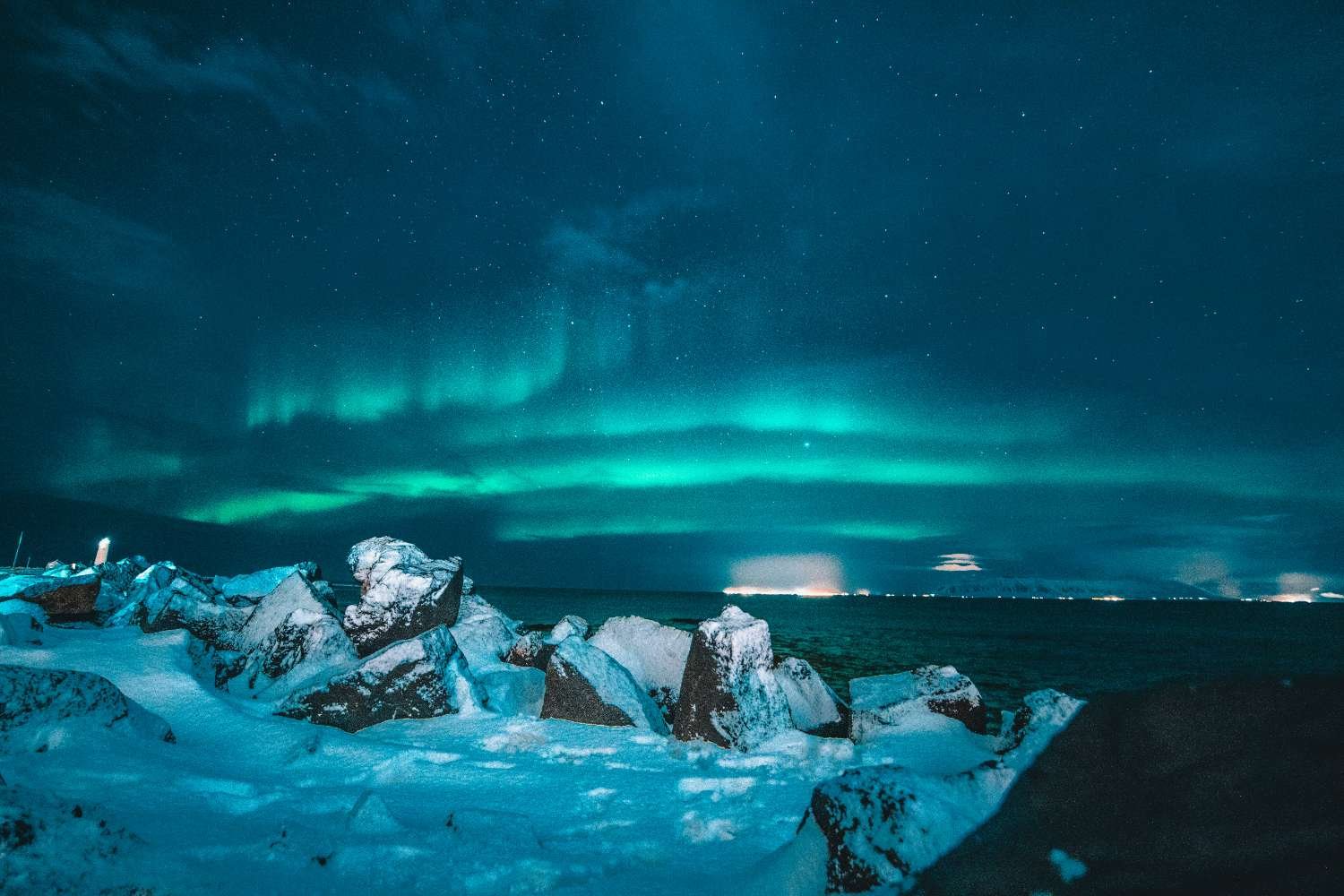
On a clear night in Greenland the aurora often starts as a pale, grey-green arc that you might mistake for a thin cloud. Then it brightens, splits into bands, and begins to ripple and move across the sky, sometimes for a few minutes, sometimes for hours. Greenland is one of the best places on Earth to see it: the country sits close to the auroral oval, the ring around the magnetic pole where the lights are most frequent, and away from the towns the nights are as dark as they get. You don’t need luck as much as you need a clear sky, a dark spot and patience. This guide explains all three.
Northern lights in Greenland in 30 seconds
- Visible from about September to early April, when nights are dark
- Clouds and light pollution matter more than the aurora forecast
- Kangerlussuaq’s dry inland climate gives the most clear nights
- In Nuuk, walk 10 to 15 minutes from the centre to a dark spot
- Peak activity is often between about 10 pm and 2 am
- No northern lights in summer: the nights are too light
What are the northern lights?
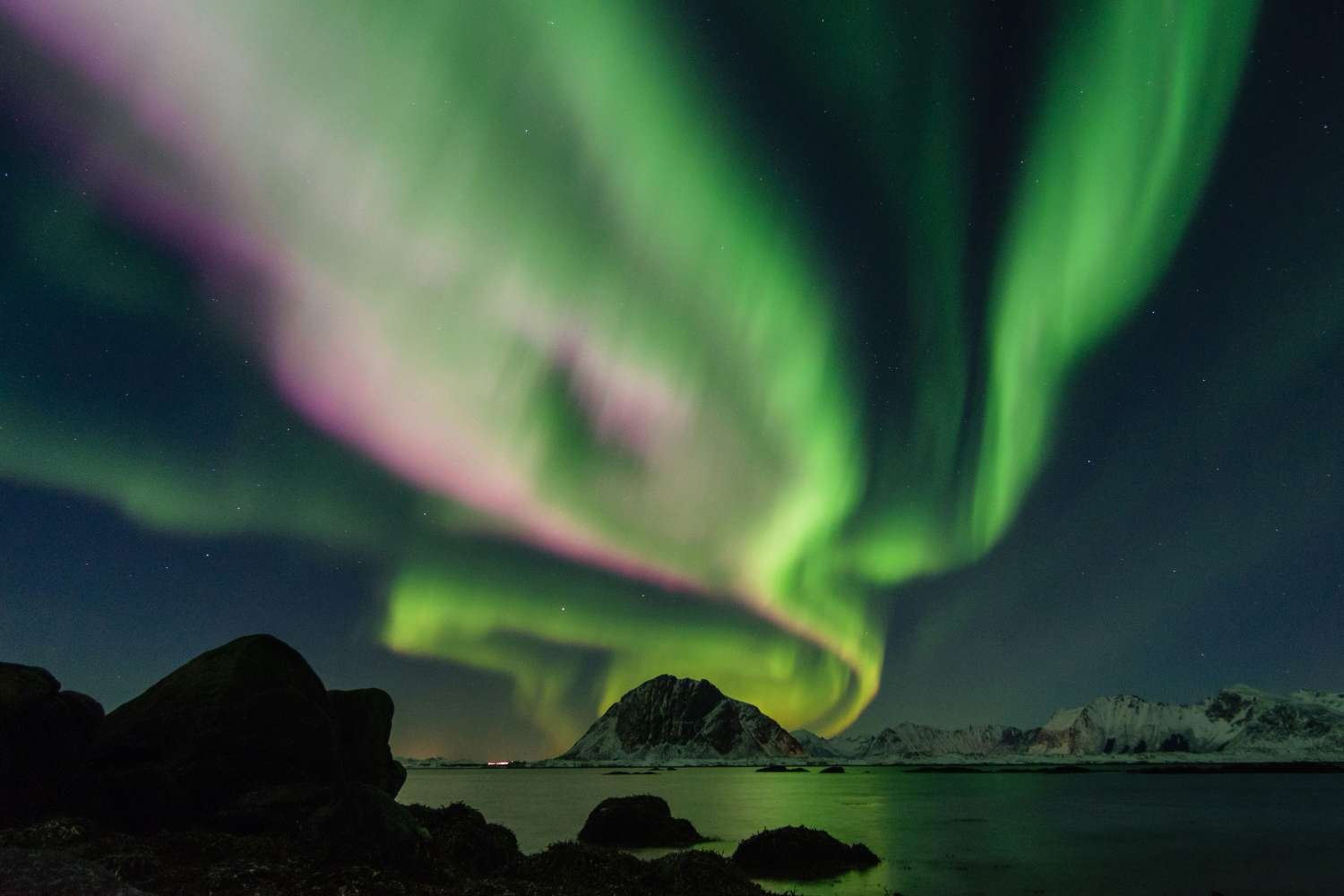
In short: the northern lights, or aurora borealis, appear when charged particles from the sun hit gases in the upper atmosphere and make them glow. Oxygen gives the common green, and at greater heights red; nitrogen adds pink and purple edges.
The sun sends out a constant stream of charged particles, the solar wind. Earth’s magnetic field steers some of them towards the polar regions, where they collide with oxygen and nitrogen about 100 to 300 kilometres above the ground. Each collision releases a little light. Because the magnetic field funnels the particles into a ring around each magnetic pole, the aurora appears most often in a band called the auroral oval. Greenland lies close to the northern magnetic pole, which puts much of the country near or under that band.
The aurora changes with the strength of the solar wind. On quiet nights it may be a still, faint arc. During stronger activity it forms curtains that ripple, pulse and fill the sky, and on rare nights it moves so fast it seems to dance. In Greenlandic tradition, the lights were the spirits of the dead playing ball with a walrus skull; the Greenlandic word for the aurora is arsarnerit, the ball players.
What are your chances tonight?
Three things decide whether you see the aurora: cloud, activity and darkness. Change them below and watch the sky.
Cloud is the factor that ends most aurora nights: even a strong display is invisible behind a thick layer of cloud. Activity decides how bright and lively the lights are, but in Greenland even low activity often produces something visible, because the country is so close to the auroral oval. Light pollution is the factor you control: a ten-minute walk away from the street lights makes a faint aurora visible and a good one spectacular.
When can you see the northern lights in Greenland?
In short: from about late August to early April, whenever the sky is dark and clear. September, October, February and March are good compromises: dark nights for the aurora and enough daylight for other activities. From mid-April to mid-August the nights are too light.
| Months | Darkness | Why go |
|---|---|---|
| Late Aug – Sep | Short dark nights, growing fast | Aurora plus boats, whales and autumn colours |
| Oct – Nov | Long nights | Many dark hours, few visitors, first snow |
| Dec – Jan | Longest nights, polar night in the north | Most dark hours, Christmas in Nuuk; little daylight |
| Feb – Mar | Long nights, bright days | Aurora plus dog sledding and sea ice |
| Early Apr | Short nights | Last chance, best further south |
| Mid-Apr – mid-Aug | Too light | No aurora; midnight sun and boat season instead |
Within a night, the aurora is often most active in the hours around local midnight, roughly between 10 pm and 2 am, but it can appear as soon as the sky is dark and last until dawn. Geomagnetic activity also tends to be a little higher around the equinoxes in March and September. The moon matters less than people think: a full moon brightens the sky and washes out faint displays, but a strong aurora is easy to see by moonlight, and the moon lights up snowy landscapes nicely in photos. For month-by-month planning, see our best time to visit Greenland guide.
Where is the best place to see the northern lights in Greenland?
In short: Kangerlussuaq, inland in West Greenland, has the most clear nights thanks to its dry climate. Nuuk is the easiest to reach and has the most to do by day. Ilulissat and Sisimiut combine the aurora with dog sledding in late winter.
| Place | Aurora conditions | Good to know |
|---|---|---|
| Kangerlussuaq | Dry inland air, many clear nights, little light pollution | Very cold; step away from the airport buildings |
| Nuuk | Coastal clouds more often; dark spots a short walk away | International flights, tours and restaurants |
| Ilulissat | Dark skies over the Icefjord | Polar night until mid-January; sledding Feb – Apr |
| Sisimiut | Dark skies over mountains and sea | Sledding and skiing in late winter |
| South Greenland | Milder, longer winter days | Good in September and early autumn |
Kangerlussuaq sits at the head of a long fjord next to the ice sheet, far from the open sea. Its continental climate means drier air and fewer clouds than on the coast, and the settlement is small, so darkness is close at hand. Many domestic flights pass through it, which makes it easy to add one or two aurora nights to a trip. On the coast, weather systems from the sea bring cloud more often, but the clear nights there are just as dark, and the views of the aurora over icebergs in Ilulissat or over Sermitsiaq in Nuuk are hard to beat.
Look everywhere: Greenland is so close to the auroral oval that the lights often appear overhead or in the southern part of the sky, not only to the north as in southern Scandinavia. Turn around and look up.
Where to see the northern lights in Nuuk
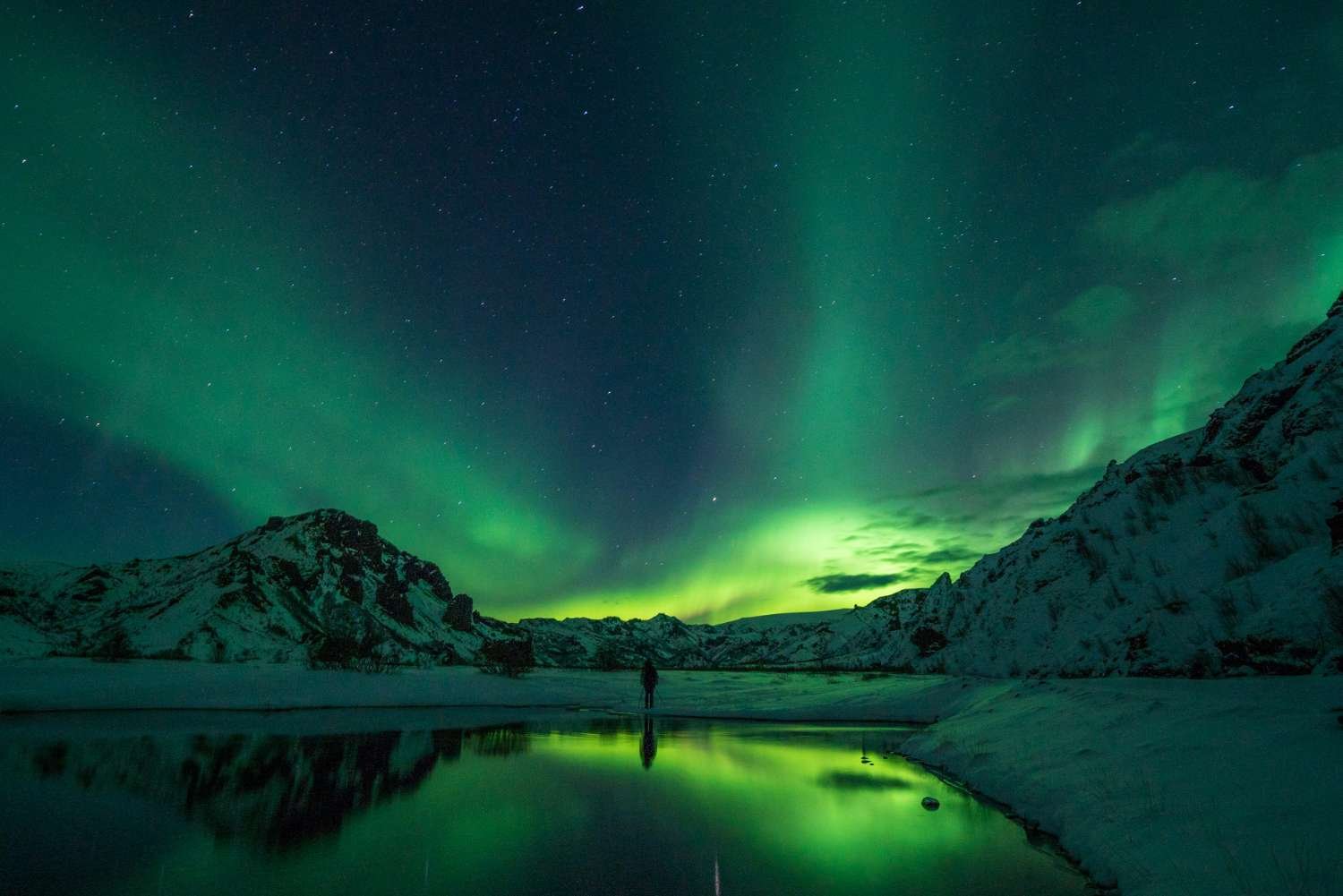
In short: walk away from the street lights of the centre. The shore below the old town, the edges of the newer districts and the lower slopes of the hills behind the city are all within a short walk or taxi ride. Local operators also run guided evening aurora trips.
Nuuk is a small city, and darkness is never far. The shoreline around the Colonial Harbour gives you a wide view over the water towards Sermitsiaq, with only the old town’s lamps behind you. The edges of Qinngorput, the newest district, open onto rock and lakes. On a strong night you will see the aurora even from the centre, but faint displays need real darkness. Wherever you go, wear shoes with grip or ice spikes, carry a headlamp, and agree on a meeting point if you split up. Taxis are easy to call for the ride back.
For company and local knowledge, the Nuuk tour operator Raw Arctic runs a guided two-hour northern lights tour from the city in the evening, starting from DKK 1,400, sold on its own website. On GetYourGuide there are currently no aurora tours in Greenland, so the table below lists the bookable Nuuk tours that fit an aurora trip by day or in the evening.
How to read the northern lights forecast
In short: check two forecasts every afternoon. The cloud forecast for your town tells you if you can see the sky. The aurora forecast, often given as the Kp index from 0 to 9, tells you how active the lights are expected to be. In Greenland, a low Kp is often enough.
For clouds, use the Danish Meteorological Institute (DMI), which covers Greenland, or any weather app with an hour-by-hour cloud cover forecast. Look for a gap in the clouds after dark, even a short one. For the aurora, the NOAA Space Weather Prediction Center publishes the Kp index and a short-term aurora forecast, and many aurora apps use its data and can send you alerts. The Kp index measures how disturbed Earth’s magnetic field is. In central Europe you need a high Kp to see anything; in Greenland, close to the oval, Kp 1 to 3 can already give a good display.
Forecasts are only a guide. The aurora can flare up with no warning and fade just as fast, so on a clear night it is worth stepping outside every half hour, even when the forecast is low. Set an alarm, keep your warm clothes by the door, and check the sky before you go to bed.
Tours for a northern lights trip to Nuuk
In short: spend the dark evenings looking for the aurora and the days on tours. Evening and indoor tours suit the long nights; the scenic drive helps you find dark viewpoints by day; boat trips run on calm days. Filter by what fits your aurora trip.
| Tour | Why it fits | From | Book |
|---|---|---|---|
| Hidden Gems Scenic DriveAurora tip2 h · private · pickup | Viewpoints over the fjord you can return to after dark | €351 | Tickets |
| Walk with Greenlandic Beer & Arctic Sliders2 h · private · 18+ | An evening out before you head into the dark | €268 | Tickets |
| Greenlandic Food Tasting & Storytelling2 h · indoors | Warm indoor evening with Arctic food and stories | €767 | Tickets |
| Old Town Walk & Kaffemik2 h · private · pickup | Ask your host about the aurora legends | €535 | Tickets |
| Walking Tour with National Museum2 h · museum entry included | Fits easily into short winter daylight | €241 | Tickets |
| City Highlights by Car with Tasting3 h · private · pickup · ★ 4.7 (4) | Heated car in the cold; good after a late aurora night | €428 | Tickets |
| Guided Running Tour65 min · pickup · ice spikes | Short daylight activity; ice spikes lent | €66 | Tickets |
| Nuuk Fjord Sightseeing Boat Tour2 h · max. 6 · heated boat | Calm-day option in September and March | €506 | Tickets |
8 tours · “From” prices as listed on GetYourGuide. There are no northern lights tours on GetYourGuide in Greenland at the moment. Affiliate links: we may earn a commission at no extra cost to you.
A good aurora day in Nuuk looks like this: sleep in after a late night, take a city tour or museum walk in the midday light, eat early, check the forecasts around sunset, and head out once it is fully dark. More ideas are in things to do in Nuuk, and the winter seasons are covered in Greenland in winter and Greenland in December.
How to photograph the northern lights
In short: use your phone’s night mode or a camera on a tripod, with a wide lens, manual focus at infinity, a high ISO and an exposure of a few seconds. Keep batteries warm and include something in the foreground.
Modern phones photograph the aurora surprisingly well. Switch to night mode, rest the phone on something steady or a small tripod, and hold still for the few seconds it takes. The camera often shows more colour than your eyes, because our eyes see poorly in the dark: a faint grey arc can come out bright green on the screen. With a camera, set manual mode and try these starting points, then adjust:
| Setting | Start with | Why |
|---|---|---|
| Lens | Wide angle, as open as possible (f/2.8 or lower) | Lets in more light and fits more sky |
| Focus | Manual, on a bright star or distant light | Autofocus fails in the dark |
| ISO | 800 – 3200 | Higher for faint aurora, lower when bright |
| Exposure | 2 – 15 seconds | Shorter for fast-moving lights, to keep detail |
| Stability | Tripod and a 2-second timer | Avoids shake when you press the button |
Put something in the foreground for scale and place: the coloured houses of Nuuk, an iceberg, a mountain or a person standing still. Cold drains batteries fast, so keep spares in an inside pocket and swap them often. When you come back indoors, leave your camera in a closed bag for an hour so condensation forms on the bag, not inside the lens.
What to wear for the northern lights
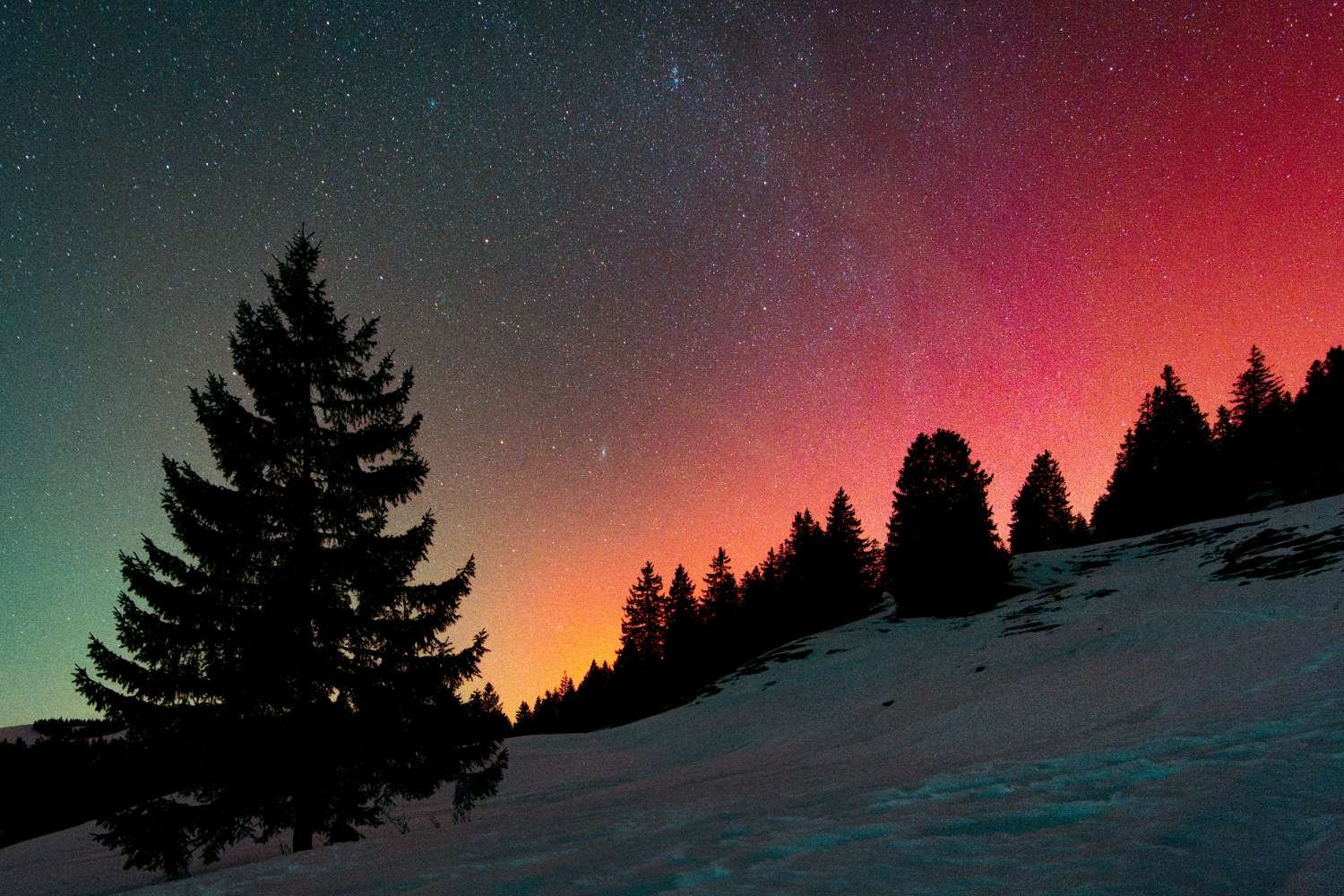
Watching the aurora means standing still outside at night, often for an hour or more, and that is colder than anything you do by day. Wear thermal underwear, a fleece or down middle layer, an insulated windproof parka and trousers, insulated boots, a warm hat, a neck gaiter, and mittens over thin liner gloves so you can use your phone. Put a chemical hand warmer in each mitten and one in your boots on the coldest nights. Bring a headlamp with a red-light mode, which helps you see without spoiling your night vision, and a thermos with something hot. Full lists are in what to wear in Greenland.
Northern lights myths
“It has to be extremely cold.” Temperature has nothing to do with the aurora; cold nights are often clear, which is why the two seem linked. A clear, mild September night is just as good.
“You can see it in summer.” The aurora is there all year, but from mid-April to mid-August Greenland’s nights are too light to see it.
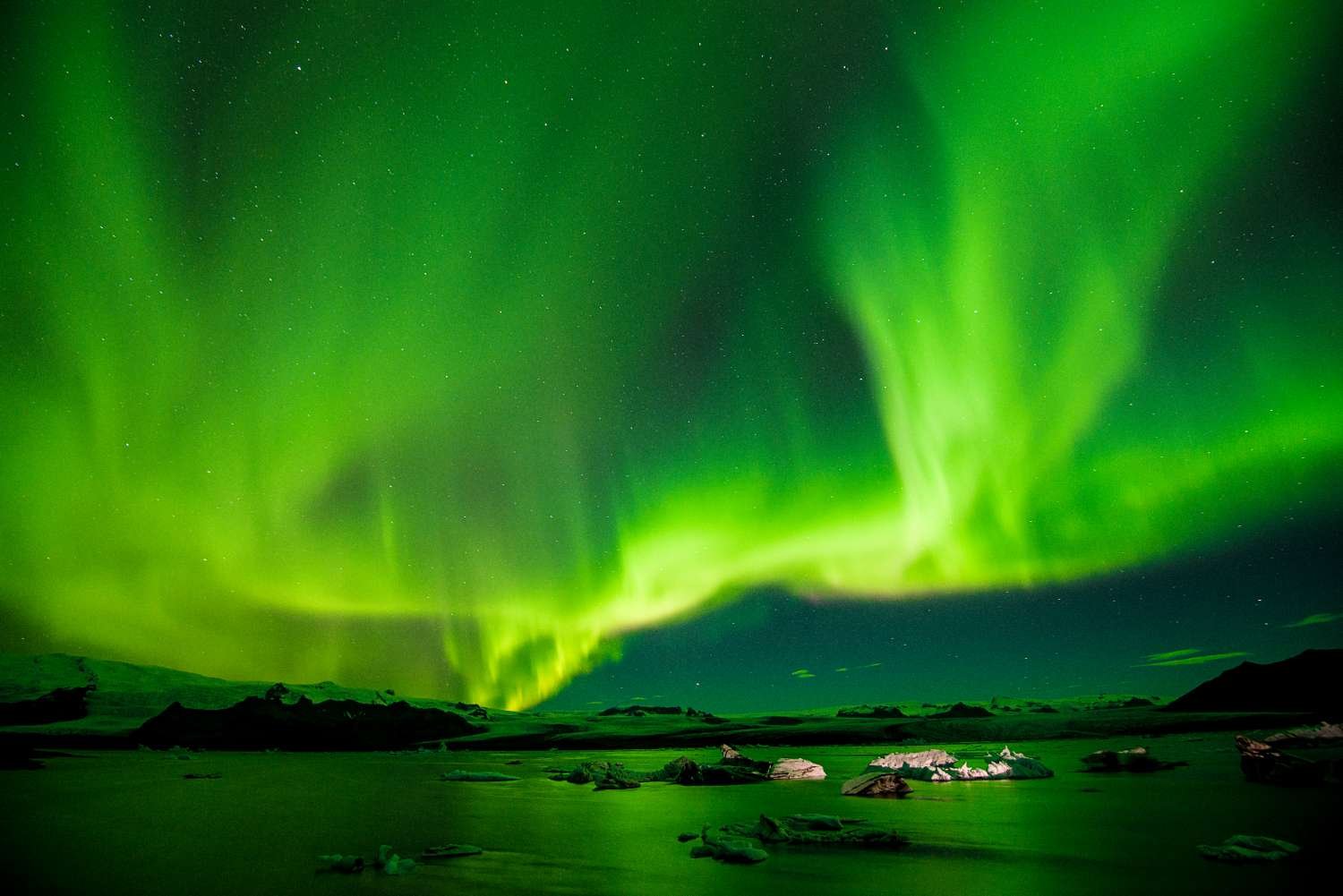
“It always looks like the photos.” Strong displays can be as bright and colourful as photos, but faint ones look grey-green to the eye, and the camera brings out the colour. Both are real aurora.
“A high Kp forecast guarantees a show.” Clouds can hide everything, and the aurora can be strong on a low-Kp night. Clear skies matter more.
Waiting for dark in Nuuk?
Find the best viewpoints by day on a scenic drive.
Questions about the northern lights in Greenland
When can you see the northern lights in Greenland?
From about late August to early April, on clear, dark nights. September to March is the main season.
What is the best month to see the northern lights in Greenland?
Any month from September to March works. September, October, February and March combine dark nights with enough daylight for other activities.
Where is the best place to see the northern lights in Greenland?
Kangerlussuaq has the most clear nights thanks to its dry inland climate. Nuuk, Ilulissat and Sisimiut are also good, with dark spots a short walk from town.
Can you see the northern lights in Nuuk?
Yes. On clear nights from September to early April, walk away from the street lights to the shore or the edge of town. Strong displays are visible even from the centre.
What time of night is best for the northern lights?
Activity is often strongest between about 10 pm and 2 am, but the aurora can appear any time it is dark.
Can you see the northern lights in Greenland in summer?
No. From mid-April to mid-August the nights are too light, and north of the Arctic Circle the sun doesn’t set in midsummer.
What Kp index do I need in Greenland?
Often only Kp 1 to 3, because Greenland is close to the auroral oval. A clear sky matters more than a high Kp.
Are there northern lights tours in Nuuk?
Yes, local operators such as Raw Arctic run guided evening northern lights tours, sold on their own websites. GetYourGuide currently lists no aurora tours in Greenland.
Which direction should I look?
Everywhere, including straight up. Greenland is so close to the auroral oval that the lights often appear overhead or in the southern sky.
Does a full moon stop the northern lights?
No, but it brightens the sky and hides faint displays. Strong aurora is easy to see by moonlight.
Can I photograph the northern lights with my phone?
Yes. Use night mode and hold the phone very still or rest it on something. Phones often show more colour than your eyes see.
Why do the northern lights look grey to my eyes?
Human eyes see colour poorly in the dark. Faint aurora looks grey-green; stronger displays show clear green and sometimes pink or purple.
What is the Greenlandic word for the northern lights?
Arsarnerit, which refers to ball players: in Greenlandic tradition, the lights were the spirits of the dead playing ball.
What should I wear to watch the northern lights?
Full winter clothing plus an extra layer: thermal underwear, a down layer, an insulated parka and trousers, warm boots, hat, neck gaiter, mittens and hand warmers.